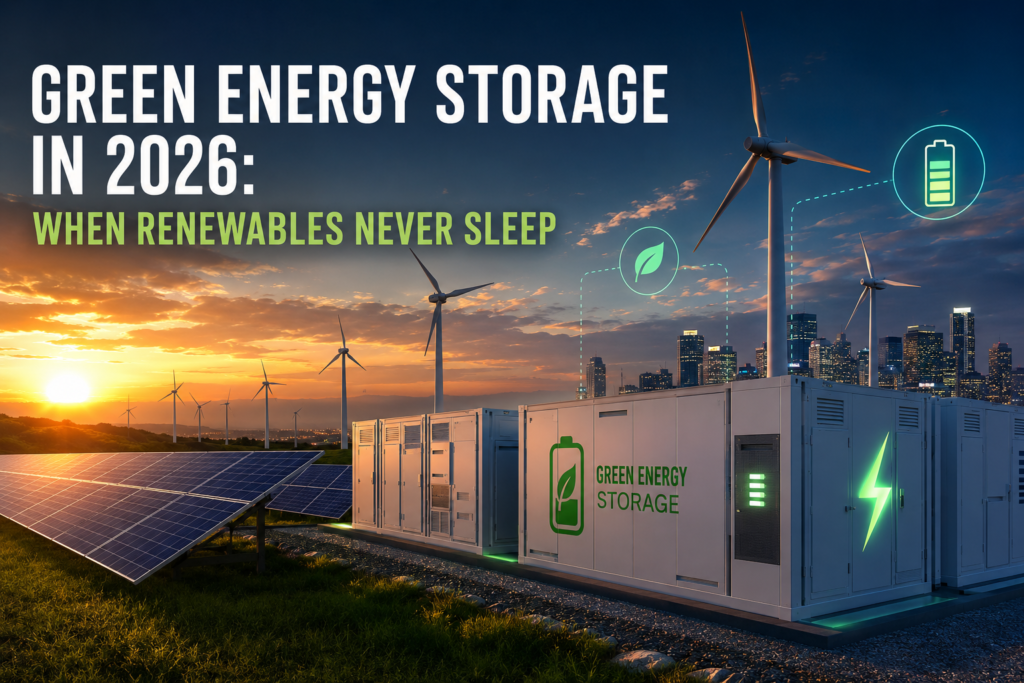

The sun goes down. The wind dies. For decades, that meant clean power went offline — but in 2026, that calculus is finally changing. A wave of commercially viable green energy storage technologies is scaling faster than most analysts predicted, and the grid is beginning to look different because of it.
Renewable energy has always carried one stubborn liability: supply and demand rarely align. Solar panels generate electricity when the sun shines, not when families cook dinner at 7 p.m. Wind turbines spin on breezy nights when demand sits at its lowest, then fall quiet during afternoon heat waves that strain air conditioners and hospitals. For years, critics used this intermittency gap as proof that renewables could never fully replace fossil fuels — that a reliable grid would always need gas-fired peaker plants on standby. In 2026, that argument is losing ground fast. Green energy storage solutions ranging from 100-hour iron-air batteries to hydrogen-based seasonal storage are stepping into the gap between generation and demand. This article breaks down what is working, who is building it, where it is being deployed at real scale, and what the next 18 months are likely to bring.
What Is Green Energy Storage? A Plain-Language Overview
Green energy storage refers to technologies that capture electricity produced from renewable sources — solar, wind, hydro — and hold it for release at a later time when it is needed most. Think of it as a rechargeable buffer for the power grid: it absorbs energy when there is a surplus and releases it when demand peaks or generation drops.
The concept is not new. Pumped hydropower — pumping water uphill when electricity is cheap, then releasing it through turbines when prices spike — has been running grids for nearly a century. What has changed dramatically in 2026 is the breadth of commercially viable options beyond pumped hydro, and the falling costs that are making novel chemistries economically competitive with fossil fuel backup at grid scale.
The International Energy Agency’s Breakthrough Agenda Report 2026 identifies energy storage — and green hydrogen in particular — as the single most critical enabling technology for achieving net-zero electricity systems. Storage allows a grid built on variable renewables to behave as reliably as one anchored by always-on coal or gas, effectively decoupling the moment of generation from the moment of consumption.
How It Works (Without the Jargon)
Every storage technology follows the same basic cycle: energy goes in during off-peak or surplus periods, gets converted into a storable form, and comes back out as electricity when it is needed. Lithium-ion batteries — the same basic chemistry in your smartphone — excel at storing energy for two to six hours. They charge and discharge quickly, returning roughly 85–95% of the electricity put in, and their costs have dropped by 90% over the past decade. But scaling them to cover 24-hour or multi-day gaps gets expensive fast, because more storage time means more of the same scarce battery cells.
That is why long-duration alternatives matter. Power Generation Advancement explains the key trade-off clearly: hydrogen’s round-trip efficiency runs only 35–40% — meaning you lose more energy in the conversion cycle — but the cost of adding storage hours is minimal because you are simply adding more storage vessel, not more expensive electrochemical material. For weekly or seasonal storage, where there is no lithium-ion alternative at scale, this trade-off is not just acceptable — it is the only viable option.
Why Green Energy Storage Is Trending Right Now
The convergence of three forces makes 2026 a defining year: falling hardware costs, a record pipeline of storage-paired renewable projects, and the first wave of long-duration commercial deployments producing real-world data. Analysts and grid operators are no longer debating whether storage can anchor a renewable grid — they are now negotiating contracts and procurement schedules.
Key developments as of July 2026:
- Long-duration storage exits pilot mode — The Rocky Mountain Institute’s 2026 Energy Transition Report identifies 2026 as the breakout year for long-duration energy storage. Flow batteries, thermal storage, and iron-air systems are all moving toward commercial operation, targeting multi-hour and multi-day storage gaps that lithium-ion cannot cost-effectively fill.
- Solar-plus-storage undercuts diesel in 50+ countries — The World Bank confirmed in early 2026 that solar-plus-storage systems are now cheaper than diesel generation in more than 50 countries. The Bank and development finance institutions have committed over $8 billion toward storage-enabled clean energy access in emerging economies through 2027.
- The hydrogen era officially begins — Global electrolyzer manufacturing costs have dropped sharply, and the IEA’s Breakthrough Agenda marks 2026 as the year green hydrogen transitions from isolated pilots to core grid infrastructure in leading economies. New infrastructure subsidy programs have launched simultaneously in the EU, Japan, South Korea, and Australia.
- 45 GW of U.S. battery storage planned this cycle — Deloitte’s 2026 Renewable Energy Industry Outlook reports that U.S. developers plan to deploy 84 GW of utility-scale solar and 45 GW of batteries in 2026–2027 combined. Only 15 GW of new natural gas capacity is planned for the same period — a decisive shift in what grid operators are choosing to build.

Real-World Applications You Should Know About
Green energy storage is already operating at meaningful scale across the United States, Europe, and Asia. These are not demonstration projects with press releases — they are commercial facilities serving real grids and real customers.
Grid-Scale Iron-Air: Form Energy’s 100-Hour Breakthrough
Form Energy is rewriting the economics of long-duration storage. The Massachusetts-based company’s iron-air batteries store energy by oxidizing iron — a slow, controlled rusting process — and recover it by reversing that reaction using electricity. The result is a battery capable of discharging continuously for over 100 hours at a cost structure that dramatically undercuts lithium-ion for multi-day applications.
The economics work because iron is one of the most abundant and inexpensive materials on earth. Unlike lithium-ion cells, which become exponentially more expensive when scaled from 4-hour to 100-hour storage, iron-air systems hold cost-per-kilowatt-hour steady as storage duration increases — because adding capacity means adding more iron, not more scarce lithium or cobalt. By 2026, Form Energy has moved beyond its initial Georgia pilot to signed utility contracts in multiple U.S. states. Energy Digital ranks Form Energy among the top ten global energy storage companies for 2026 — a position that reflects how rapidly iron-air chemistry has moved from laboratory curiosity to bankable grid asset.
Germany’s Virtual Power Plant: 15,000 Batteries as One
While the United States focuses on utility-scale deployments, Germany is demonstrating what distributed storage looks like when properly orchestrated. Aggregators Next Kraftwerke and Sonnen are now coordinating more than 15,000 decentralized battery units — installed in homes, businesses, and small industrial sites — as a single synchronized network. In early 2026, this platform successfully completed a transition from simple frequency response contracts to cross-market optimization: batteries in German households now trade energy in real time on the wholesale electricity market.
This matters because it proves that green energy storage does not require a single large facility. A well-connected network of smaller, distributed units provides equivalent grid-balancing services — and it can be built incrementally, one household at a time, without the permitting timelines and grid connection costs that delay utility-scale projects.
Key Players You Should Know
The green energy storage landscape in 2026 spans energy giants, well-funded startups, and institutions deploying capital at a scale not seen since the early days of utility-scale solar. Here are six names defining the sector:
- Form Energy — Iron-air battery pioneer scaling from pilot to multi-state commercial utility contracts in the United States. Targeting 100+ hour storage at costs below any competing long-duration technology.
- Energy Vault SA — Swiss company deploying hybrid systems that integrate gravity-based storage, lithium-ion, and green hydrogen under a proprietary energy management platform. Its flexibility gives utilities optionality that single-chemistry providers cannot match.
- NineDot Energy — Building and operating community-scale BESS across New York City’s five boroughs and surrounding counties. NineDot plans to complete more than 400 MW of clean energy systems by end of 2026, making it one of the most visible urban storage deployments in North America.
- NextEra Energy — The world’s largest clean energy company by installed capacity, operating wind farms, solar arrays, and battery storage at scale across the United States. Its operating data gives it outsized influence on storage procurement economics.
- Photoncycle — Norwegian startup that raised a new investment round in early 2026, targeting residential green hydrogen storage for home delivery in 2027. If successful, it could bring seasonal storage to individual homeowners for the first time (ESS News).
- Bloom Energy — Named to TIME’s Top GreenTech Companies of 2026, Bloom’s solid oxide fuel cells are now powering AI data centers facing grid reliability constraints, bridging stationary storage and distributed clean generation in enterprise settings (Fuel Cells Works).
Challenges and What Critics Say
No sector growing this fast is without friction. Green energy storage in 2026 faces four substantial headwinds that honest advocates should not minimize.
Capital cost and financing pressure remain the largest deployment barriers. Grid-scale storage projects require massive upfront capital, and with interest rates staying elevated through 2026, the cost of debt is compressing project returns. Deloitte’s Renewable Energy Outlook specifically flags high cost of debt, permitting bottlenecks, and grid interconnection queues as the top obstacles slowing storage rollout in both the United States and Europe.
Policy uncertainty is creating real investment risk. In the United States, the expedited phaseout of the 45Y and 48E clean energy tax credits — affecting projects beginning construction after July 4, 2026 — threatens to raise storage development costs at exactly the moment the industry is reaching commercial maturity. At the state level, Ohio has sunset its renewable portfolio standards after 2026, while North Carolina softened its 2030 carbon target, both citing consumer electricity cost concerns.
Hydrogen’s efficiency gap is a genuine limitation. The Power-to-Gas-to-Power cycle — renewable electricity to electrolyzer to hydrogen to fuel cell back to electricity — typically recovers only 35–40% of original input energy. For daily grid balancing, that round-trip loss makes green hydrogen significantly more expensive than lithium-ion storage. Hydrogen earns its place only in seasonal applications where no cost-competitive alternative exists.
Environmental trade-offs deserve honest scrutiny. The U.S. Government Accountability Office’s 2026 hydrogen technology assessment (GAO-26-107932) notes that large-scale electrolyzer operation requires significant fresh water inputs, and the land footprint required for solar and wind arrays to power green hydrogen production raises legitimate ecological concerns in water-scarce regions.

What This Means for You
The green energy storage buildout is not only a story for grid operators and utilities. Its effects are rippling across business, real estate, investment, and careers.
Business owners and industrial operators in markets with volatile peak pricing should evaluate commercial battery storage now rather than waiting. The economics for commercial and industrial BESS are compelling in high-peak-price markets, and subscription-based models from aggregators like Sonnen allow access to storage benefits without requiring direct capital ownership.
Real estate developers and builders should anticipate building codes evolving toward storage-readiness mandates. California and New York are already moving in this direction, and the European Union’s revised energy performance standards are expected to treat on-site storage as standard infrastructure in new construction.
Technology professionals will find growing demand for grid-edge software skills: orchestrating thousands of distributed battery assets is a data engineering and systems problem as much as an electrical one. Companies hiring for this intersection of energy and software include utilities, aggregators, and dedicated grid software startups.
Investors should treat the storage sector as highly differentiated. Commodity battery cell manufacturing is a different risk profile than long-duration storage hardware or grid software platforms. Knowing which layer you are investing in matters enormously.
Looking Ahead: What to Watch in 2027
Three developments will determine whether 2026’s storage momentum becomes a permanent structural shift:
- Iron-air commercial validation at scale — Form Energy’s first multi-utility commercial contracts will produce real performance data by mid-2027. If the technology delivers its promised 100+ hour discharge with acceptable degradation, it will trigger a procurement wave that locks iron-air into the long-duration market for the decade ahead.
- Green hydrogen cost trajectory — The IEA’s Breakthrough Agenda calls for clear infrastructure investment commitments in 2026–2027. If electrolyzer manufacturing scales at learning rates comparable to solar PV, green hydrogen production costs could approach $2 per kilogram by 2030, making it directly competitive with natural gas peakers as backup generation.
- U.S. policy stabilization or adaptation — The July 2026 tax credit phaseout creates near-term uncertainty, but Deloitte’s analysts note that solar-plus-storage in the U.S. sunbelt is approaching unsubsidized cost parity with gas peakers — a milestone that removes subsidy dependence from the investment equation.
Conclusion
Green energy storage in 2026 is not a vision for the future — it is infrastructure being installed right now, at commercial scale, on four continents. Iron-air batteries in the American Midwest, 15,000-unit virtual power plants in Germany, home hydrogen storage pilots in Norway, and a 45 GW battery pipeline in the United States all tell the same story: renewable energy’s core weakness is being engineered away, one deployed megawatt-hour at a time.
The obstacles are real — capital costs, policy reversals, efficiency trade-offs, and ecological concerns will slow parts of the buildout. But the direction is no longer in doubt. For the first time in the history of electricity generation, the storage technologies capable of keeping a renewable-powered grid running through the night, through the winter, and through demand spikes all exist at commercial scale and are falling in cost. The question now is execution speed — and in 2026, that speed is accelerating.
Stay ahead of the clean energy transition — explore our full coverage of green technology and sustainability on eazytechsol.com.