

Digital Product Passports: Business Compliance and Circular Economy
Digital product passports are becoming one of the most practical technology trends for manufacturers, retailers, importers, logistics providers, and circular economy teams in 2026.
The idea is simple: a physical product should have a reliable digital record that travels with it across design, manufacturing, sale, repair, reuse, resale, and recycling. The execution is much harder. Companies need product identifiers, supplier data, material records, compliance evidence, lifecycle updates, access controls, and systems that can share data with regulators, partners, customers, and recyclers.
That is why digital product passports are not just a sustainability policy. They are a data infrastructure project.
The European Union’s Ecodesign for Sustainable Products Regulation gives the digital product passport a central role in future product rules. The EU Battery Regulation is one of the clearest near-term examples: from 18 February 2027, several battery categories, including electric vehicle batteries and industrial batteries above 2 kWh, will need an electronic battery passport.
For business leaders, the question is no longer whether product data will matter. It is whether their data is complete, trusted, machine-readable, and useful enough to support compliance and new circular business models.
Why Digital Product Passports Are Trending Now
Digital product passports are trending because three forces are converging.
First, regulators want more product transparency. Product sustainability claims, material content, repairability, carbon footprints, responsible sourcing, and end-of-life handling are difficult to verify when records are scattered across spreadsheets, supplier portals, PDFs, and enterprise resource planning systems. A passport creates a structured way to expose the right data to the right audience.
Second, circular economy business models need better information. Repair, refurbishment, resale, parts harvesting, remanufacturing, and recycling all depend on knowing what a product is, what it contains, how it was used, and how it should be handled. Without that data, circular operations become manual, slow, and expensive.
Third, global supply chains are already digital, but their data is fragmented. A product may involve raw material suppliers, component makers, contract manufacturers, certification labs, logistics partners, marketplaces, repair networks, and recyclers. A passport does not replace those systems. It gives them a common product record to connect around.
The strongest business opportunity is not a QR code on a package. It is the operational layer behind that QR code.
What a Digital Product Passport Actually Contains
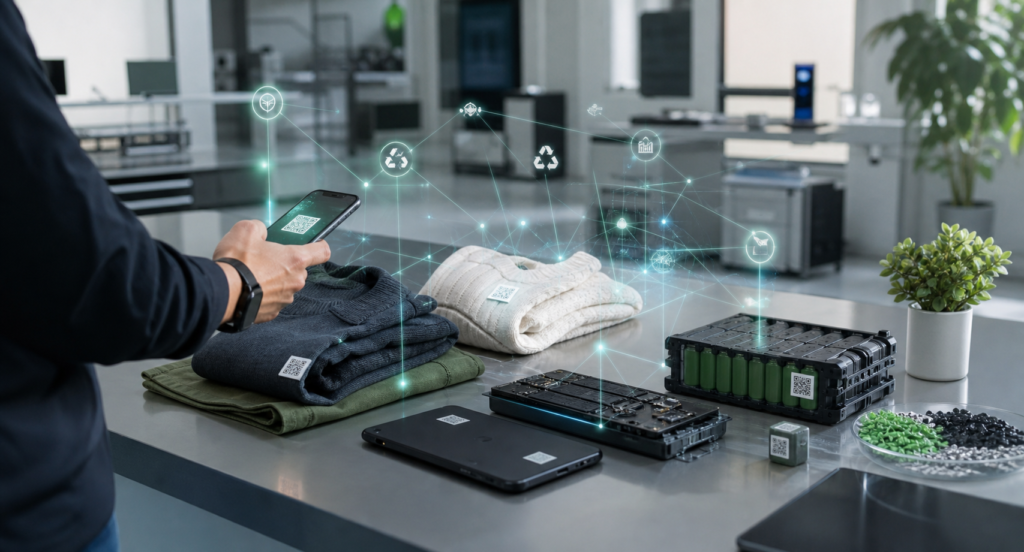
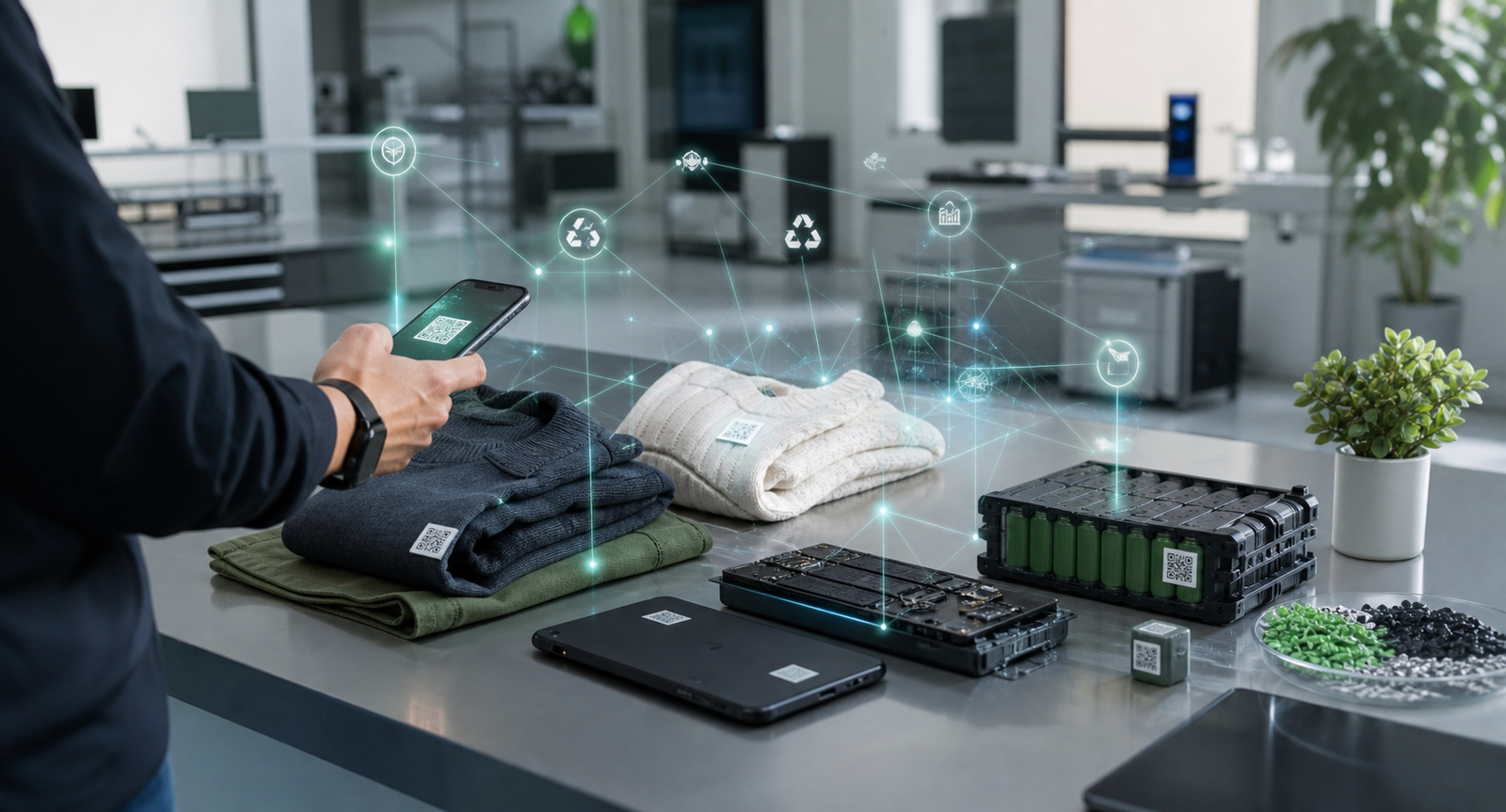
A digital product passport is a digital record linked to a physical product, batch, model, component, or material. It may be accessed through a QR code, NFC tag, RFID tag, serial number, or another data carrier. The exact data requirements depend on the product category and regulation, but many passports will include:
- Unique product identifiers
- Manufacturer, importer, and responsible operator details
- Material composition and restricted substance information
- Origin and supply chain evidence
- Sustainability and environmental indicators
- Repair, maintenance, spare parts, and disassembly guidance
- Certifications, declarations, and conformity evidence
- Carbon footprint or recycled content data where required
- Battery health, condition, or usage data for relevant battery applications
- End-of-life instructions for reuse, recycling, or safe disposal
The passport also needs access rules. A consumer may see care, repair, authenticity, or recycling guidance. A recycler may need material and disassembly data. A regulator may need compliance evidence. A supplier may need to update a limited field. A competitor should not receive confidential product design data.
This is why digital product passports require governance, not only software.
Real-World Applications
Batteries and Electric Vehicles
Batteries are the leading real-world test case because they combine regulatory pressure, safety requirements, valuable materials, and strong circular economy potential.
An electric vehicle battery passport can help answer practical questions:
- What chemistry and materials are inside the battery?
- Where did critical materials come from?
- What carbon footprint evidence is available?
- What is the battery’s state of health?
- Is the battery suitable for repair, second-life energy storage, or recycling?
- Which safety and handling instructions apply?
For manufacturers, the passport supports market access and compliance. For fleet operators, it can improve residual value and maintenance decisions. For recyclers, it can reduce uncertainty and improve material recovery. For insurers and used vehicle markets, it can make battery condition more transparent.
The technical work is not trivial. Battery data changes over time, and some condition data may come from battery management systems, service events, or diagnostics. That creates a need for secure updates, data quality checks, and clear rules about which data is static and which data is dynamic.

Textiles, Apparel, and Consumer Goods
Textiles are another high-impact category because fashion supply chains are complex and product-level data is often incomplete. A garment may involve fiber sourcing, dyeing, finishing, manufacturing, packaging, shipping, resale, repair, and recycling partners.
A digital product passport can help brands provide composition details, care instructions, repair options, origin information, authenticity checks, and recycling guidance. It can also support resale marketplaces by improving product verification and item history.
The business challenge is supplier data. Many brands have reasonable visibility into their Tier 1 manufacturers but weaker visibility further upstream. If a passport requires fiber origin, chemical treatment, recycled content, or environmental data, brands need stronger supplier onboarding, audit trails, and data exchange standards.
For retailers and marketplaces, passports can become a trust feature. Customers may scan a product to verify authenticity, learn how to care for it, find replacement parts, or understand disposal options. The same data can support internal compliance and reduce the cost of manual documentation.
Electronics and Repairability
Electronics companies can use digital product passports to improve repair, spare parts planning, warranty support, and recycling. A passport could link a device to model-specific repair instructions, component information, software support status, hazardous material details, and recycling instructions.
This is valuable because electronics often have high embedded carbon, complex materials, and short replacement cycles. Better product records can help businesses extend product life, recover components, and prove compliance with product safety or environmental rules.
For service teams, the benefit is speed. Instead of searching disconnected systems, a technician can scan the product and retrieve the right version of the documentation. For recyclers, material and disassembly data can improve sorting and recovery. For customers, repairability information can influence buying decisions.
Industrial Equipment and Construction Materials
Digital product passports are also useful for long-lived assets such as machinery, building products, and industrial components. These products may remain in service for years or decades, so documentation often gets lost before the product reaches repair, resale, or end-of-life.
A passport can preserve product identity, maintenance records, material composition, safety instructions, and compliance documents. In construction, material passports can help building owners understand what materials are embedded in a building and how they might be reused, recovered, or safely disposed of later.
This changes how companies think about assets. A product is no longer only a sold item. It becomes a managed data object with lifecycle value.
Business Impact: Compliance Is Only the Starting Point
Many companies will first adopt digital product passports because they must comply with product rules. That is understandable, but it is a narrow view of the opportunity.
Digital product passports can also create business value in five ways.
1. Faster Compliance Evidence
Compliance teams often spend too much time chasing documents from suppliers, labs, and internal teams. A passport-ready data model can reduce manual work by connecting required evidence to the product record.
That does not remove legal responsibility. It makes compliance more operational and less reactive.
2. Better Supply Chain Visibility
Passports force companies to define what they know about products and where that knowledge comes from. This can expose weak supplier data, unclear ownership, outdated certificates, and inconsistent identifiers.
Those findings are useful beyond regulation. They improve procurement, quality control, risk management, and supplier performance reviews.
3. New Customer and After-Sales Experiences
A product passport can support customer-facing services such as authenticity checks, care guidance, spare parts ordering, warranty validation, repair booking, resale verification, and recycling instructions.
This gives brands a reason to maintain a relationship with the product after the first sale.
4. Higher Resale, Repair, and Recycling Value
Products with trusted lifecycle data are easier to value. A used battery with verified condition data is more useful than one with unknown history. A garment with accurate material data is easier to route into resale, repair, or recycling. An industrial part with maintenance records may retain more value in secondary markets.
Data does not create circularity by itself, but poor data can block circularity from scaling.
5. AI-Ready Product Operations
Once product data is structured, organizations can use analytics and AI more effectively. Teams can forecast failure risk, identify products suitable for refurbishment, detect supplier data gaps, optimize recycling routes, and prioritize products with the greatest environmental or commercial impact.
The key is data quality. AI will not fix missing supplier evidence or inconsistent product identifiers.

The Technology Stack Behind a Passport
A practical digital product passport stack usually includes several layers.
The first layer is product identity. Companies need consistent identifiers for models, batches, serial numbers, components, and materials. Without strong identity, passport data cannot be reliably linked to physical products.
The second layer is the data carrier. This may be a QR code, NFC tag, RFID tag, digital watermark, or another machine-readable method. The carrier should remain readable across the product’s expected life and use conditions.
The third layer is the data platform. The passport needs structured records, update workflows, version history, validation rules, and integrations with ERP, product lifecycle management, supplier management, quality, service, and recycling systems.
The fourth layer is access control. Not everyone should see the same data. A good passport architecture separates public, partner, regulator, and restricted data.
The fifth layer is trust. Companies need to know who provided each data point, when it changed, what evidence supports it, and whether it was verified. This is where digital signatures, audit trails, credential systems, and carefully scoped blockchain or distributed ledger approaches may help. Blockchain is not required for every passport, but tamper-evidence and provenance are important.
The sixth layer is interoperability. A passport should not become a proprietary dead end. Businesses should watch standards work from groups such as CEN-CENELEC and industry initiatives such as Battery Pass because technical requirements are still maturing.
Risks and Implementation Challenges
Digital product passports can fail if companies treat them as a last-minute website project. The main risks are operational.
Bad Supplier Data
Supplier data may be incomplete, inconsistent, manually entered, or difficult to verify. Companies need clear data requirements, supplier training, validation checks, and escalation paths before deadlines arrive.
Confidentiality and Competitive Exposure
Product data can reveal sensitive information about suppliers, materials, design, pricing, or manufacturing processes. Passport systems need access tiers so companies can comply without exposing trade secrets unnecessarily.
Durability of the Data Carrier
A QR code on a label may be enough for some products. It may fail for harsh environments, long-lived assets, batteries, industrial parts, or products that are washed, repaired, repackaged, or recycled. The carrier strategy should match the product lifecycle.
Fragmented Standards
Many organizations are working on standards, schemas, and implementation guidance. Early movers should design for flexibility because detailed requirements can change by product group.
Greenwashing Risk
A passport can make sustainability claims more visible, but visibility also increases accountability. Weak evidence, vague sourcing claims, or outdated environmental data can create reputational and regulatory risk.
A Practical Roadmap for Businesses
Companies do not need to wait for every final standard before preparing. They can start with actions that will remain useful.
1. Map Product Categories and Exposure
Identify which products are likely to face digital product passport requirements first. Batteries, textiles, electronics, furniture, steel, aluminium, and other high-impact categories deserve early attention.
2. Build a Minimum Product Data Model
Define the core product data fields your organization must trust: product ID, material composition, supplier evidence, certifications, repair guidance, safety data, recycled content, carbon data, and end-of-life instructions.
3. Audit Supplier Readiness
Ask suppliers what data they can provide today, in what format, how often it changes, and what evidence supports it. This will reveal gaps earlier than a compliance deadline.
4. Choose Data Carriers by Product Reality
Match QR, NFC, RFID, or other carriers to product conditions. Consider durability, scan environment, consumer access, recycling workflows, and anti-counterfeiting needs.
5. Create Access Rules
Separate public information from regulator, partner, and confidential data. Decide who can read, update, verify, revoke, or archive passport records.
6. Pilot With a Product Line
Start with one product family where compliance pressure and business value are both clear. Batteries, premium apparel, electronics accessories, spare parts, or reusable packaging can be strong candidates.
7. Connect Passport Data to Business Workflows
Do not leave passport data isolated. Use it in service, warranty, quality, resale, procurement, sustainability reporting, and recycling decisions.
What Readers Should Watch Next
The next 12 to 24 months will be important for digital product passports.
Watch battery passport implementation because it will show how companies handle dynamic lifecycle data, assurance, and real-world data carrier issues.
Watch EU delegated acts and product-group requirements because they will define the exact fields, timing, access rules, and compliance expectations for different sectors.
Watch standards and interoperability work because global companies will need passport systems that work across borders and supply chains.
Watch the service provider market. Many small and mid-sized businesses will not build full passport infrastructure alone, so DPP-as-a-service platforms, supplier data networks, certification tools, and traceability integrations will grow quickly.
Most importantly, watch whether companies treat digital product passports as a compliance checkbox or as a product data foundation. The second approach is harder, but it creates more value.
FAQ
What are digital product passports?
Digital product passports are structured digital records linked to physical products, components, or materials. They can store product identity, compliance, sustainability, repair, lifecycle, and end-of-life information.
Are digital product passports only required in Europe?
The EU is currently the strongest regulatory driver, but global manufacturers and brands that sell into the EU may be affected. Similar traceability expectations are also emerging through voluntary industry programs, retailer requirements, and sustainability reporting.
Do digital product passports require blockchain?
No. A passport can be built with conventional databases, APIs, access controls, and audit trails. Blockchain or distributed ledger technology may be useful for some provenance or tamper-evidence use cases, but it is not required for every implementation.
Which products should businesses prioritize first?
Start with products that face near-term regulation, high material value, complex supplier data, repair or resale potential, or end-of-life risk. Batteries, textiles, electronics, industrial parts, and reusable packaging are good places to assess first.
How should a company start?
Begin with a product data audit. Identify what data exists, who owns it, where it lives, how reliable it is, which suppliers must contribute, and which users need access. Then pilot a passport workflow for one product line before scaling.
Sources
- Regulation (EU) 2024/1781: Ecodesign for Sustainable Products Regulation
- Regulation (EU) 2023/1542: Batteries and waste batteries
- European Commission: Ecodesign for Sustainable Products Regulation
- Battery Pass: digital battery passport guidance and project resources
- CEN-CENELEC: European standardization organizations
- Vogue Business: Fashion is lurching toward a compliance reckoning