

Agentic Ransomware: How AI Agents Are Changing Cybersecurity in 2026
Agentic ransomware is becoming one of the most important cybersecurity trends of 2026 because it changes the speed and economics of cybercrime. The core ransomware problem is familiar: attackers break in, steal or encrypt data, disrupt operations, and demand payment. What is changing is the role of AI agents in coordinating the work.
In a traditional ransomware campaign, humans or scripted malware perform separate tasks: scan exposed systems, exploit a vulnerability, collect credentials, move through the environment, find valuable data, encrypt systems, and write an extortion note. An agentic ransomware workflow uses an AI agent to plan, execute, observe results, correct mistakes, and call tools across those same steps.
That does not mean every attacker now has a fully autonomous cyber weapon. It does mean security teams should prepare for a world where reconnaissance, credential abuse, vulnerability triage, and extortion workflows happen faster and with less human labor.

Why Agentic Ransomware Is Trending Now
The immediate trigger is a reported case that cybersecurity researchers described as the first documented example of agentic ransomware. Business Insider reported that Sysdig researchers identified a campaign called Jade Puffer, where a large language model agent allegedly orchestrated ransomware activity. ITPro reported that the incident involved a known flaw in Langflow, credential access, database control, encryption, and a ransom note, while also noting that a human still set up infrastructure and selected the target.
That nuance matters. The near-term threat is not a movie-style autonomous attacker that invents brand-new exploits from nothing. The practical risk is attack compression. AI agents can automate repetitive steps, retry failed commands, summarize exposed data, select the next action, and reduce the time between initial access and business impact.
This is why agentic ransomware is a business issue, not only a security research topic. If attackers can move faster, companies have less time to detect, contain, and recover. Controls that were acceptable when an investigation took hours may fail when an agent can test multiple paths in minutes.
What Makes It Different From Normal Ransomware
Ransomware has been automated for years. Worms, scripts, exploit kits, credential stuffing tools, and ransomware-as-a-service platforms are not new. Agentic ransomware is different because the automation becomes adaptive.
A conventional script follows a fixed path. If a command fails, the script may stop or move to a pre-coded fallback. An AI agent can observe the failure, infer why it happened, choose another tool or query, and continue. It can also combine natural-language reasoning with technical actions such as shell commands, database queries, file searches, API calls, and cloud-console operations.
The business impact is a shorter decision loop for attackers:
- Find an exposed service or vulnerable application
- Collect credentials, tokens, secrets, or cloud keys
- Identify high-value databases, storage buckets, backups, and financial records
- Test access and permissions
- Exfiltrate or encrypt selected data
- Generate an extortion message customized to the environment
- Iterate when blocked
For defenders, the most important lesson is that agentic ransomware attacks the same weak points companies already know about: unpatched services, excessive privileges, exposed secrets, poor network segmentation, unmanaged AI tools, weak logging, and untested recovery plans.
Real-World Business Applications And Risks
Faster Reconnaissance Against Exposed Systems
AI agents are useful at reading documentation, testing assumptions, and chaining small tasks. In an offensive setting, that can make external reconnaissance faster. An agent can inspect exposed services, compare version information with known vulnerabilities, summarize likely entry points, and prepare the next command.
This is especially risky for businesses with internet-facing admin panels, poorly maintained SaaS integrations, development environments exposed to the public internet, or shadow IT assets that do not appear in the official inventory.
The business response is not exotic. Keep an accurate asset inventory, continuously scan the public attack surface, patch externally exposed systems first, and remove abandoned services. Companies that cannot answer “what do we have on the internet today?” are easier targets for automated reconnaissance.
Credential And Secret Abuse At Scale
Agentic ransomware is most dangerous when it gets access to valid credentials. Passwords, API keys, cloud tokens, database connection strings, and service-account secrets can let an attacker bypass many perimeter controls.
An AI agent can search for secrets in files, environment variables, code repositories, CI/CD logs, notebooks, shared drives, and configuration stores. It can then test which credentials work and what permissions they carry.
For business leaders, this makes identity governance a ransomware control. Phishing-resistant MFA, short-lived credentials, secret scanning, least-privilege service accounts, rapid key rotation, and strong offboarding workflows are not optional hygiene. They directly reduce how far an AI-assisted intrusion can travel.
Data Extortion Beyond Backups
Backups help restore encrypted systems, but they do not solve data theft. Modern ransomware often uses double extortion: steal sensitive information first, then threaten publication, regulatory exposure, or customer notification.
Agentic workflows can make this worse by quickly locating the data that creates leverage. Customer records, contracts, product roadmaps, financial models, source code, identity documents, and health or legal files are all more useful to attackers than random folders.
The practical defense is data minimization and classification. Companies should know where sensitive data lives, who owns it, how long it must be retained, and which systems can access it. A business with clean data governance has fewer high-value targets and can scope an incident faster.
How Businesses Should Defend Against Agentic Ransomware
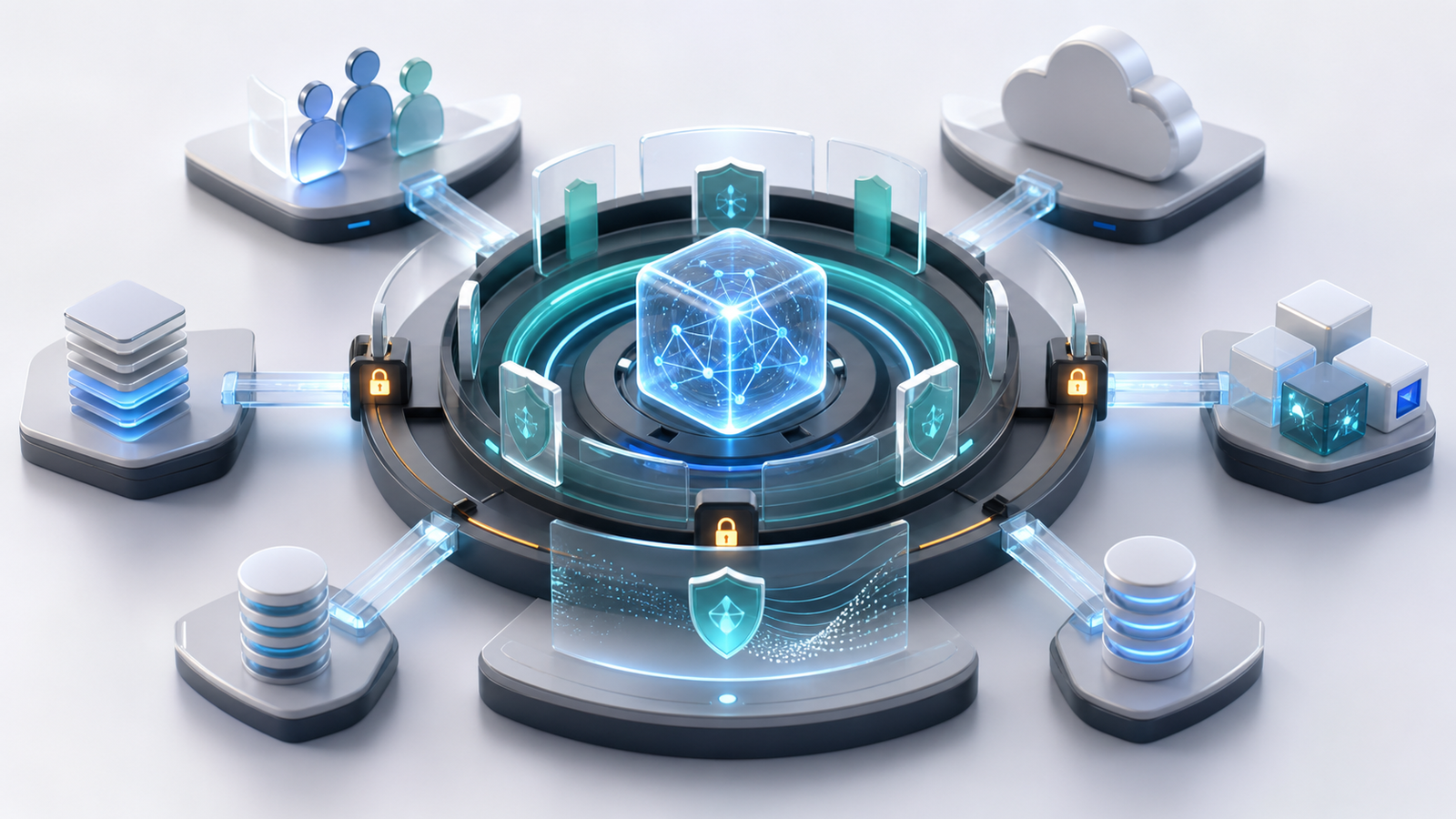
1. Reduce The Attack Surface Before Automation Finds It
The first defense is still boring and effective: patch exposed systems, close unnecessary ports, retire unused applications, and inventory internet-facing assets. Agentic attacks benefit from easy options. Removing those options forces the attacker into harder, noisier paths.
Prioritize systems that combine exposure with high privilege: remote access tools, VPNs, CI/CD services, identity providers, admin dashboards, cloud consoles, databases, backup portals, and AI workflow platforms.
2. Treat Identity As The New Perimeter
If an AI agent can operate with stolen credentials, it inherits the permissions attached to those credentials. Strong identity controls can limit the blast radius.
Focus on:
- Phishing-resistant MFA for privileged and remote access
- Conditional access policies for unusual devices, locations, and impossible travel
- Least privilege for users, service accounts, and automation tools
- Just-in-time admin access instead of standing privileges
- Secret scanning across repositories, CI/CD pipelines, and cloud storage
- Automated credential rotation after suspicious activity
3. Put Guardrails Around Your Own AI Agents
Businesses are also deploying internal AI agents for support, software development, analytics, security operations, and workflow automation. These agents can become risk points if they have too much access or if employees connect them to sensitive tools without review.
The OWASP Top 10 for LLM Applications is useful for understanding risks such as prompt injection, sensitive information disclosure, and excessive agency. The MITRE ATLAS knowledge base also gives security teams a structured way to think about adversary tactics against AI-enabled systems.
Practical controls include tool allowlists, approval gates for high-impact actions, scoped tokens, audit logs, data-loss prevention, prompt and output logging where appropriate, and separation between test agents and production systems.
4. Detect Behavior, Not Just Malware Signatures
Agentic ransomware may not look like one static malware sample. It may look like a sequence of legitimate tools being used in suspicious ways: a service account reading unusual folders, a database exporting large volumes, a cloud key listing storage buckets, or a script touching backups.
Security teams should monitor for behavior patterns:
- Sudden secret discovery or credential testing
- Unusual database enumeration
- Large data exports from sensitive repositories
- Backup deletion or snapshot changes
- New admin accounts, API keys, or OAuth grants
- Rapid file encryption or mass permission changes
- Unexpected calls from AI tools into production systems
The goal is to catch the chain early, before extortion begins.
5. Practice Recovery Under Compressed Timelines
Ransomware readiness should include tabletop exercises, restore testing, legal decision points, communications templates, cyber insurance contacts, law-enforcement escalation, and customer notification procedures.
The CISA StopRansomware Guide remains a useful reference for prevention, response, and recovery planning. The key update for 2026 is speed: run exercises as if the attacker can move quickly, adapt when blocked, and search for the most sensitive data first.

Opportunities For Defenders
The same agentic AI pattern can also help defenders. Security teams can use AI agents to triage alerts, summarize logs, draft incident timelines, search documentation, enrich indicators, validate controls, and automate low-risk containment steps.
The opportunity is not fully autonomous defense without accountability. The opportunity is better human-in-the-loop security operations. An agent can collect context quickly; a trained analyst can approve the action that affects production systems.
This is where the NIST AI Risk Management Framework is relevant. NIST describes the AI RMF as a voluntary framework for managing risks to individuals, organizations, and society, and it has also published a generative AI profile. For companies adopting AI in security operations, that means governance, measurement, accountability, and risk monitoring should be built into the deployment plan.
What To Watch Next
Agentic ransomware will likely evolve in four directions.
First, attackers will use agents to reduce dwell time. The gap between initial access and data theft may shrink further.
Second, criminals will target AI workflow tools themselves, especially systems with secrets, plugins, database connections, and automation permissions.
Third, security vendors will add more agentic defense capabilities, including alert investigation, cloud posture triage, and automated containment recommendations.
Fourth, regulators and insurers will ask harder questions about AI-agent governance, identity controls, backup integrity, and incident response testing.
The companies that adapt fastest will not be the ones chasing every new AI security product. They will be the ones that strengthen the fundamentals: identity, patching, observability, data governance, recovery, and scoped automation.
Practical Checklist For The Next 30 Days
- Inventory internet-facing assets and remove what should not be exposed.
- Prioritize patches for remote access, AI workflow, database, cloud, and identity systems.
- Require phishing-resistant MFA for privileged users and remote access.
- Scan code repositories and CI/CD logs for secrets.
- Review service-account permissions and remove standing admin access.
- Confirm backups are isolated, immutable where possible, and restorable.
- Add detections for unusual data export, secret discovery, and backup tampering.
- Run a ransomware tabletop exercise with legal, communications, IT, security, and operations.
- Review internal AI agents for tool permissions, logging, and approval gates.
FAQ
Is agentic ransomware fully autonomous?
Not necessarily. The reported examples still involve human setup, targeting, or infrastructure. The important change is that AI agents can automate and adapt parts of the attack chain that previously required more manual work.
Does this make traditional ransomware defenses obsolete?
No. It makes the basics more urgent. Patching, MFA, least privilege, logging, segmentation, data governance, and tested recovery remain the highest-value defenses.
Should businesses ban AI agents?
A blanket ban is rarely realistic. A better approach is governance: inventory AI agents, limit their permissions, log their actions, require approval for high-impact tasks, and keep production secrets away from untrusted workflows.
What is the biggest near-term risk?
Credential abuse. If an AI agent obtains valid credentials with excessive privileges, it can move quickly through systems, find sensitive data, and trigger extortion workflows before defenders understand the scope.
Bottom Line
Agentic ransomware is a warning about speed, not magic. Attackers are using AI to make familiar ransomware steps cheaper, faster, and more adaptive. Businesses should respond by reducing exposed attack paths, tightening identity, governing AI agents, improving behavioral detection, and practicing recovery under compressed timelines.