


Edge AI in 2026: Real-World Uses, Risks, and ROI
Edge AI is becoming one of the most practical technology trends of 2026 because it changes where artificial intelligence runs. Instead of sending every image, sensor reading, voice command, machine signal, or medical measurement to a distant cloud service, businesses can run AI models on local devices, gateways, cameras, machines, vehicles, and edge servers.
That shift matters because many useful AI decisions are time-sensitive. A factory camera spotting a defect cannot wait for a slow network. A clinical device should not send more patient data than necessary. A robot needs local perception and control. A retail checkout system has to keep working when connectivity is unstable. Edge AI is not replacing cloud AI, but it is becoming the missing layer between connected devices and centralized platforms.
The trend signal is strong. IBM defines edge AI as deploying AI models directly on local edge devices such as sensors and IoT devices, enabling real-time processing without constant cloud reliance. NVIDIA is positioning Jetson Thor for physical AI and robotics workloads at the edge, including real-time sensor processing. In the chip market, recent reporting on Onsemi’s planned Synaptics acquisition framed the deal as a move into edge AI and physical AI, combining sensing, power, connectivity, compute, and control.
For business leaders, the question is not whether edge AI sounds impressive. The practical question is where local inference creates measurable value, where cloud AI is still better, and what operational risks come with managing thousands of intelligent endpoints.

What Edge AI Means
Edge AI is the use of machine learning or generative AI models near the place where data is created. That place could be a camera, vehicle, wearable, retail shelf, inspection station, industrial robot, medical device, gateway, or small local server.
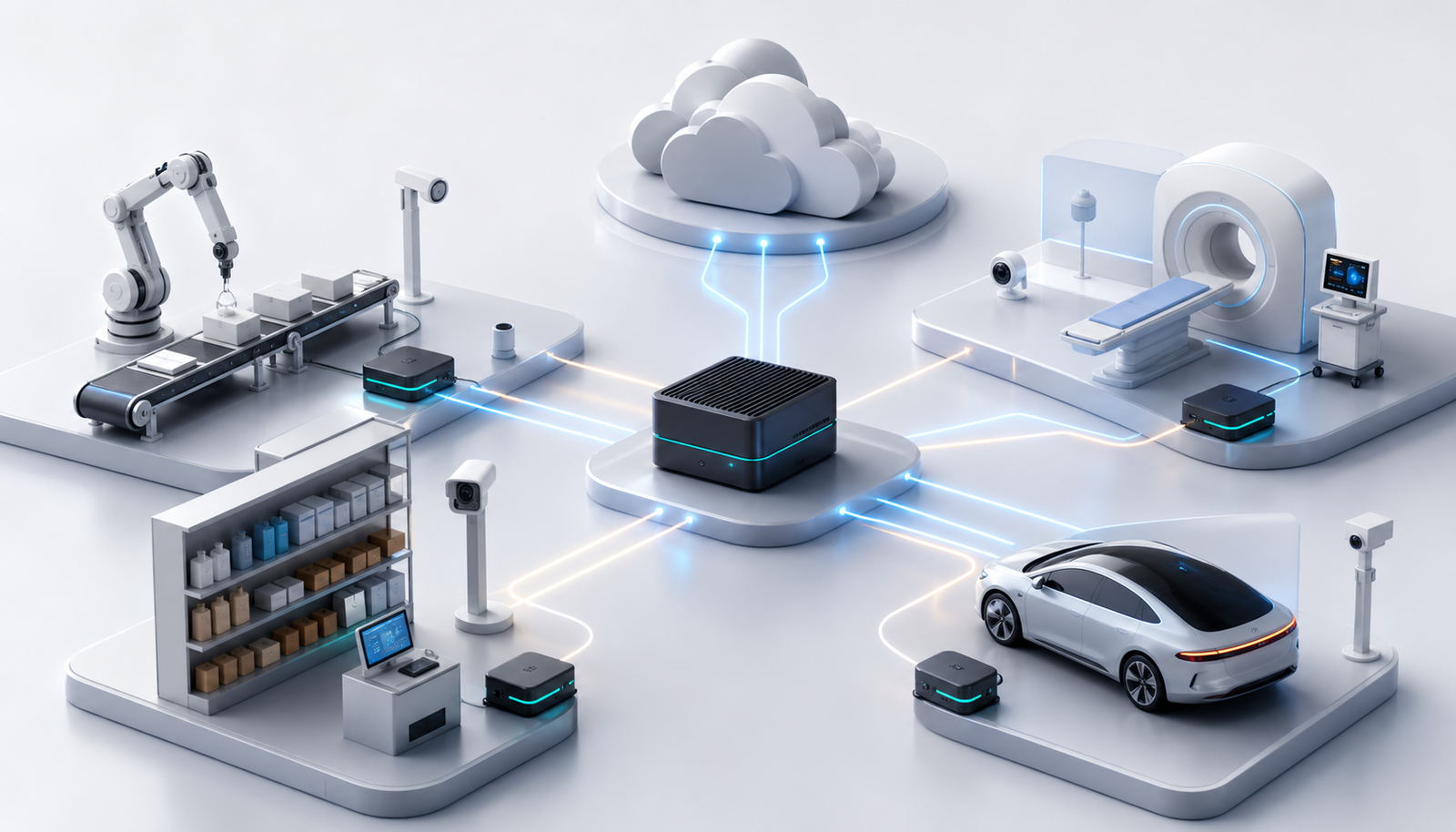
In a typical edge AI architecture, the cloud still matters. Large models are often trained, evaluated, updated, and monitored centrally. The edge layer handles local inference, filtering, anomaly detection, safety logic, and quick responses. The cloud handles heavy training, fleet analytics, long-term storage, and cross-site coordination.
This hybrid model is important. A company does not need to choose between cloud AI and edge AI. The stronger pattern is cloud plus edge:
- Train, test, and govern models centrally.
- Deploy optimized versions to devices or gateways.
- Process sensitive or high-volume data locally.
- Send only useful events, summaries, exceptions, or model telemetry back to the cloud.
- Update models through a controlled lifecycle.
The business value appears when this architecture reduces latency, bandwidth cost, downtime, privacy exposure, or manual inspection effort.
Why Edge AI Is Trending Now
Edge AI has existed for years, especially in computer vision and industrial IoT. What is different in 2026 is the maturity of the stack.
First, AI accelerators are becoming more capable and more specialized. Devices now include neural processing units, embedded GPUs, vision accelerators, and low-power AI chips that can run useful models without a full data center behind them. NVIDIA’s Jetson Thor page describes compact modules for robotics and embedded edge AI, with high AI compute, sensor processing, and power envelopes designed for physical AI systems.
Second, small language models and efficient vision models are improving. Not every task needs a frontier model. Many enterprise tasks need a model that can classify defects, detect anomalies, summarize a short local transcript, identify inventory movement, or decide whether a machine is drifting out of tolerance.
Third, connected devices are creating too much data to move blindly. Factories, stores, hospitals, campuses, vehicles, farms, and utilities produce video, audio, telemetry, and environmental data continuously. Sending everything to the cloud is expensive, slow, and sometimes risky.
Fourth, physical AI is attracting investment. Recent coverage of Onsemi’s planned Synaptics acquisition highlighted a broader shift: AI is moving beyond data centers into automotive, industrial, robotics, AR/VR, and IoT systems that need sensing, compute, connectivity, and control in one deployable stack.
Real-World Applications
Manufacturing and Quality Control
Manufacturing is one of the clearest edge AI use cases. Cameras and sensors can inspect products, monitor vibration, detect abnormal heat, identify missing components, and flag safety risks on the production line.
The edge matters because manufacturing decisions are immediate. If a defect appears every few seconds, the system should stop a line, alert an operator, or divert a part without waiting for cloud processing. Local inference also reduces the amount of raw video sent across the network.
Practical examples include:
- Vision inspection for scratches, dents, packaging errors, or assembly defects.
- Predictive maintenance based on vibration, temperature, sound, or motor current.
- Worker safety alerts for restricted zones, missing protective equipment, or unsafe proximity to machinery.
- Yield optimization by detecting process drift early.
The ROI usually comes from fewer defects, less downtime, lower scrap, faster root-cause analysis, and more consistent inspection than manual sampling alone.
Healthcare and Medical Devices
Healthcare edge AI is attractive because it combines speed with privacy. A wearable, bedside device, imaging system, or ambulance system can analyze signals locally and share only the output that clinicians need.
The FDA maintains a public list of AI-enabled medical devices authorized for marketing in the United States and says the list is intended to support transparency for innovators, clinicians, and patients. That does not mean every AI medical device is an edge AI device, but it shows how quickly AI is entering regulated clinical workflows.
Edge deployments can support remote monitoring, fall detection, triage, imaging assistance, and faster alerts. The advantage is not just latency. Local processing can reduce unnecessary transmission of sensitive data, which matters for hospitals, home care, and regulated health environments.

Retail and Customer Experience
Retailers can use edge AI in smart shelves, checkout systems, loss prevention, queue analytics, planogram compliance, and in-store operations. The local approach is valuable because stores need systems that respond quickly and keep running even when network connectivity is imperfect.
For example, an edge camera can detect when a shelf is empty and trigger a restocking workflow. A checkout device can identify products locally. A store operations system can estimate wait times without storing raw video centrally. The business case depends on reduced shrink, fewer out-of-stock events, faster checkout, and better labor allocation.
Retail is also a good reminder that edge AI needs governance. Camera analytics and customer tracking can create privacy and trust risks if the system is poorly explained, over-collects data, or retains raw footage longer than needed.
Robotics, Vehicles, and Physical AI
Robots, drones, autonomous vehicles, and industrial machines need fast local perception. They cannot depend only on a round trip to the cloud to understand a workspace, avoid an obstacle, or adjust movement.
This is where physical AI becomes relevant. The system must sense, reason, act, and adapt in real time. Edge AI supports local object detection, sensor fusion, path planning, voice or gesture interaction, and operational safety checks.
The near-term business opportunity is not only humanoid robots. It includes warehouse robots, automated inspection carts, agricultural machines, delivery systems, construction equipment, and factory automation.
Energy, Utilities, and Smart Infrastructure
Utilities and infrastructure operators can use edge AI to monitor grid equipment, water systems, traffic signals, substations, pipelines, and renewable assets. Local models can detect anomalies and prioritize alerts even when field connectivity is limited.
For these organizations, edge AI can improve resilience. A remote site should continue making basic decisions during network outages. It should also reduce data transfer by sending events, compressed summaries, and maintenance signals instead of continuous raw streams.
Business Impact: Where Edge AI Creates Value
Edge AI is worth considering when at least one of five business drivers is strong.
The first driver is latency. If a decision must happen in milliseconds or seconds, local inference may be necessary.
The second is bandwidth. Video, audio, and high-frequency sensor streams are expensive to transmit and store. Local filtering can reduce cloud load.
The third is privacy and data control. Sensitive images, health signals, customer behavior, and operational data may be safer when processed locally and summarized before transmission.
The fourth is resilience. Edge systems can keep operating during network outages or cloud service interruptions.
The fifth is cost control. Cloud inference is powerful, but constant streaming and high-volume API calls can become expensive. Edge AI can reduce recurring usage costs when workloads are predictable and high-volume.
The tradeoff is operational complexity. Edge AI shifts some responsibility from centralized cloud teams to device fleets, field operations, security, and lifecycle management.
Risks Businesses Should Manage
Edge AI has real risks. Treating devices as “small cloud servers” is a mistake.
Device Security
Every intelligent endpoint can become an attack surface. Edge AI devices need secure boot, signed updates, device identity, encryption, vulnerability management, logging, and access control. NIST’s Cybersecurity for IoT Program focuses on guidance and standards for connected devices and published updated IoT manufacturer guidance in 2026, underscoring that IoT security has to cover the full product lifecycle.
Model Drift and Field Conditions
Models can perform well in a lab and fail in the field. Lighting changes, dust, vibration, new product packaging, camera angle shifts, patient differences, or seasonal changes can reduce accuracy.
Businesses need monitoring, feedback loops, rollback plans, and periodic validation. For high-risk use cases, human review should remain part of the workflow.
Hardware Fragmentation
Edge fleets are messy. A company may have different cameras, gateways, processors, operating systems, and network environments across locations. That makes deployment, observability, updates, and troubleshooting harder than centralized cloud work.
Standardizing a reference architecture before scaling is often more important than choosing the most powerful chip.
Privacy and Compliance
Local processing can improve privacy, but it does not automatically solve compliance. Businesses still need clear policies for data collection, retention, consent, access, audit logs, and cross-border transfer. Edge systems should minimize raw data by design and document what is processed locally versus sent centrally.
Cost Overruns
Edge AI can reduce cloud costs, but it introduces hardware, installation, maintenance, security, and lifecycle expenses. A pilot that works on five devices may not be economical across five thousand devices unless the team accounts for procurement, spares, remote management, and support.
How to Start an Edge AI Project
Start with a workflow, not a device. The best first projects usually have measurable pain: downtime, defects, slow response, bandwidth cost, safety incidents, fraud, queue delays, or manual inspection bottlenecks.
Then define the decision that must happen locally. If the local system only needs to detect an exception and send an alert, the model can be smaller and easier to operate. If the system must control machinery or influence clinical decisions, governance and validation must be much stronger.
A practical rollout plan looks like this:
- Pick one location, line, ward, store, or asset class.
- Baseline current cost, response time, error rate, downtime, or manual effort.
- Test models against real local conditions, not only clean lab data.
- Decide what stays local and what goes to the cloud.
- Build a device security and update plan before scaling.
- Track business metrics and model metrics together.
- Keep a human escalation path for uncertain or high-impact decisions.
The goal is not to prove that edge AI works in theory. The goal is to prove that it improves a specific operation enough to justify deployment and maintenance.
What to Watch Next
Watch small language models on devices. As compact models improve, more natural-language tasks will run near the user, including local summarization, inspection notes, maintenance assistants, and voice interfaces.
Watch physical AI platforms. Robotics and industrial automation need integrated stacks that combine sensing, compute, connectivity, control, and safety. Chip and platform acquisitions in this space show that vendors are trying to own more of the edge stack.
Watch regulation and security guidance. IoT cybersecurity, medical device AI, biometric systems, and camera analytics will face closer scrutiny as intelligent devices spread.
Watch edge-cloud orchestration. The winning architecture will not be “everything at the edge.” It will be a controlled loop where cloud systems train, test, distribute, monitor, and improve models while edge systems act quickly and locally.
FAQ
Is edge AI the same as IoT?
No. IoT connects devices and collects data. Edge AI adds local intelligence so devices, gateways, or local servers can classify, predict, detect, summarize, or act near the data source.
Does edge AI replace cloud AI?
Usually no. Most businesses need both. The cloud is still useful for training, fleet analytics, model governance, storage, and coordination. The edge is useful for fast, local, resilient decisions.
What is the best first edge AI use case?
The best first use case has a measurable operational problem and a clear local decision. Manufacturing inspection, predictive maintenance, remote monitoring, and camera-based anomaly detection are common starting points.
What is the biggest edge AI risk?
The biggest risk is unmanaged scale. A small pilot can look successful, but production requires secure devices, updates, monitoring, drift detection, privacy controls, and support across the full device lifecycle.