


Post-Quantum Cryptography Migration: Why Businesses Should Start Before Q-Day

Quantum computing is no longer only a laboratory story. The business question is becoming more practical: what happens to encrypted customer data, payment systems, connected devices, contracts, code-signing keys, and identity infrastructure when today’s public-key cryptography can no longer be trusted?
That risk is known as the post-quantum cryptography problem. A sufficiently capable quantum computer could break widely used public-key algorithms such as RSA and elliptic-curve cryptography. No one can give a reliable calendar date for that machine, often called a cryptanalytically relevant quantum computer, but waiting for certainty is the wrong strategy. Migration will take years because encryption is buried inside applications, APIs, cloud services, certificates, devices, vendor products, backups, and business workflows.
The shift is already underway. The U.S. National Institute of Standards and Technology finalized the first three post-quantum encryption standards in 2024 and encouraged system administrators to begin integrating them because full deployment takes time. NIST’s standards include ML-KEM for general encryption and ML-DSA and SLH-DSA for digital signatures. In parallel, NIST’s National Cybersecurity Center of Excellence is working with vendors and enterprises on cryptographic discovery, inventory, interoperability testing, and migration practices.
For businesses, the message is clear: post-quantum cryptography migration is now a planning, procurement, compliance, and architecture issue. It should be treated like cloud migration, zero trust, or major ERP modernization: phased, measurable, and tied to business risk.
Why Post-Quantum Cryptography Matters Now
Most companies depend on public-key cryptography every day. It protects web sessions, VPNs, software updates, payment connections, digital signatures, identity tokens, device certificates, email security, and machine-to-machine communication.
The immediate danger is not only a future quantum computer breaking tomorrow’s traffic. It is also “harvest now, decrypt later.” Sensitive encrypted data can be copied today and decrypted later if it still has value when quantum capabilities mature. That matters for medical records, legal files, government data, intellectual property, product designs, long-term financial records, merger documents, and critical infrastructure information.
The Office of Management and Budget’s M-23-02 memo directed U.S. federal agencies to inventory cryptographic systems and noted that encrypted data can be recorded now and decrypted later by a future quantum-capable attacker. Even if a business is not a federal agency, the same logic applies to any organization holding data with a long confidentiality lifetime.
This is why the smart move is not panic. It is crypto agility: knowing where cryptography exists, how quickly algorithms can be changed, and which systems must be upgraded first.
What Changed: Standards Are Here
For years, the answer to quantum risk was “monitor the standards.” That answer is no longer enough.
NIST released finalized post-quantum cryptography standards in 2024:
- FIPS 203: ML-KEM, based on CRYSTALS-Kyber, for key establishment and general encryption use cases.
- FIPS 204: ML-DSA, based on CRYSTALS-Dilithium, for digital signatures.
- FIPS 205: SLH-DSA, based on SPHINCS+, as a hash-based digital signature option.
These standards do not mean every company should rip out existing cryptography overnight. In many real systems, migration will happen through hybrid approaches, vendor upgrades, protocol updates, and carefully staged deployments. But the standards give security teams, software vendors, cloud providers, and procurement teams a common target.
NIST’s NCCoE migration project is especially useful for business readers because it focuses on the operational problem: discovering where cryptography is used, building inventories, testing interoperability, and prioritizing the systems that matter most.
Real-World Applications and Business Impact
Financial Services and Payments
Banks, fintech platforms, insurers, payment processors, and trading systems rely on strong cryptography for authentication, transaction confidentiality, message integrity, and audit trails. A quantum-safe roadmap should cover TLS, HSMs, payment APIs, customer identity, SWIFT or bank messaging integrations, document signing, mobile banking certificates, and long-lived archives.
The biggest business impact is trust. Customers rarely see cryptography, but they feel the consequences when payment systems fail, certificates break, or sensitive financial data is exposed. Early planning reduces the chance of rushed vendor replacements later.
Healthcare and Legal Records
Healthcare records, clinical research data, genomic data, legal contracts, and litigation files can remain sensitive for decades. These sectors face the harvest-now-decrypt-later problem directly because a data breach today may become more damaging in the future.
Migration planning should prioritize systems that store or transmit long-lived confidential data: patient portals, imaging systems, electronic health records, document management platforms, backup archives, identity providers, and secure messaging.
Software Development and Code Signing
Post-quantum cryptography is not only about encrypted traffic. Digital signatures prove that software updates, containers, firmware, and packages have not been tampered with. If an attacker can undermine signing systems, the supply chain risk becomes severe.
Development teams should inventory code-signing certificates, CI/CD secrets, package registries, container signing workflows, firmware update systems, and third-party build dependencies. Procurement teams should start asking software vendors how they plan to support NIST-standard post-quantum algorithms.
IoT, Manufacturing, and Operational Technology
Connected devices are difficult to upgrade. Many remain in the field for years, run constrained hardware, and depend on embedded certificates or firmware signing. That makes IoT and operational technology a high-risk area for delayed migration.
Manufacturers, energy companies, logistics firms, and smart building operators should identify which devices can receive cryptographic updates, which devices require replacement, and which vendor contracts need post-quantum language.

A Practical Roadmap for Post-Quantum Cryptography Migration
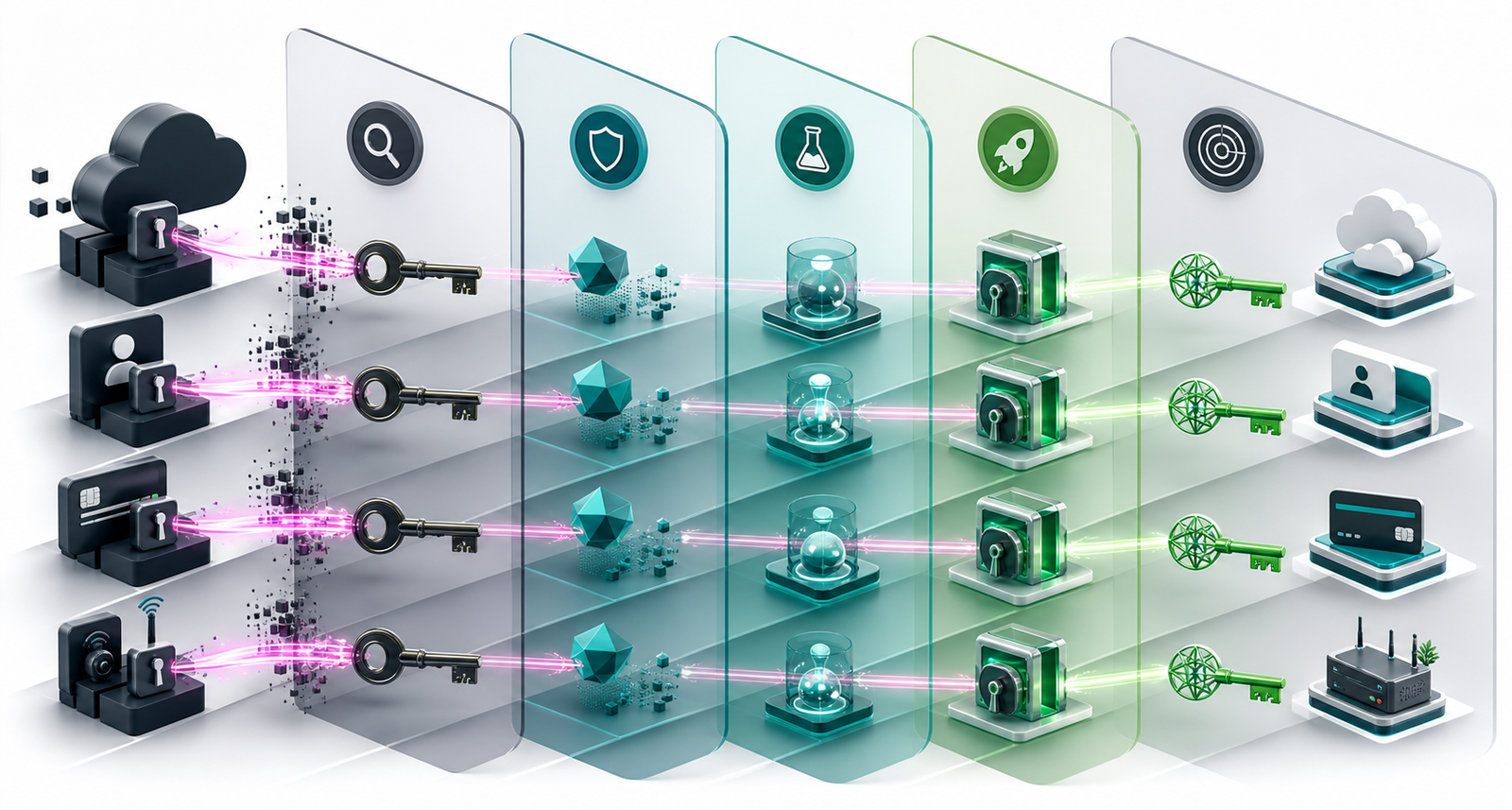
1. Build a Cryptographic Inventory
Start by finding where public-key cryptography is actually used. Look beyond websites and VPNs. Include APIs, certificates, SSH keys, S/MIME, PKI, identity systems, token signing, HSMs, databases, mobile apps, embedded systems, backups, and vendor-managed services.
For each item, capture the algorithm, key length, certificate authority, owner, vendor, data sensitivity, replacement path, expiration date, and business criticality. This inventory becomes the foundation for every later decision.
2. Rank Systems by Quantum Risk
Not every system has the same urgency. Prioritize systems that protect long-lived sensitive data, support critical business operations, depend on hard-to-upgrade devices, or face regulatory scrutiny.
A useful risk lens is data lifetime. If the data must remain confidential for 10, 20, or 30 years, it deserves earlier attention than low-value, short-lived session data.
3. Ask Vendors Better Questions
Most businesses will not implement every cryptographic primitive themselves. They will depend on cloud platforms, SaaS providers, network appliances, identity vendors, payment processors, endpoint security tools, and device manufacturers.
Add post-quantum questions to procurement and renewal processes:
- Which NIST-standard post-quantum algorithms are on the vendor roadmap?
- Will upgrades require new hardware, firmware, software licenses, or protocol changes?
- Does the product support hybrid classical-plus-post-quantum modes where appropriate?
- Can administrators rotate algorithms and certificates without downtime?
- How will the vendor handle interoperability testing?
- What telemetry proves migration progress?
4. Test Before Production Changes
Post-quantum algorithms can have different key sizes, signature sizes, performance profiles, and interoperability characteristics. Test changes in controlled environments before deploying them across critical systems.
Pay attention to load balancers, firewalls, proxies, older clients, embedded devices, certificate chains, logging systems, and monitoring tools. A cryptographic upgrade that breaks inspection, authentication, or device enrollment can become a business outage.
5. Design for Crypto Agility
The goal is not to swap one algorithm once. The goal is to make future swaps easier.
Crypto agility means cryptographic choices are configurable, visible, tested, and governed. It also means teams know who owns each cryptographic dependency and how to change it without rewriting the entire application.
Good crypto agility practices include centralized certificate management, documented key rotation procedures, automated discovery, vendor lifecycle tracking, strong asset ownership, and regular tabletop exercises for cryptographic change events.
Opportunities for Businesses
Post-quantum migration is a defensive project, but it can create business value.
First, it improves asset visibility. Many organizations do not know how much unmanaged cryptography exists across their estate. A cryptographic inventory can reveal forgotten certificates, old protocols, unsupported devices, and weak vendor dependencies.
Second, it strengthens vendor governance. Asking better questions now can prevent expensive emergency replacements later.
Third, it supports customer trust. Businesses that handle sensitive data can use quantum-safe planning as evidence of mature security governance, especially in finance, healthcare, critical infrastructure, legal services, and government contracting.
Finally, it aligns with broader modernization. Companies already working on zero trust, cloud security, DevSecOps, software supply chain protection, and IoT security can fold post-quantum readiness into those programs instead of treating it as a separate project.
Risks to Avoid
The biggest risk is treating post-quantum cryptography as a future-only issue. Migration will involve old applications, expired ownership records, hardware constraints, protocol dependencies, and vendor timelines. Those problems are slow to fix.
Another risk is deploying immature or nonstandard solutions without a business case. Follow NIST standards, test interoperability, and avoid one-off cryptography that cannot be maintained.
Businesses should also avoid assuming cloud providers will solve everything automatically. Cloud platforms will help, but customers still own architecture decisions, application dependencies, data classification, key management, device fleets, vendor selection, and compliance evidence.
What to Watch Next
Watch for three developments through 2026 and beyond.
First, more vendors will publish post-quantum support timelines for TLS, PKI, code signing, HSMs, VPNs, identity systems, and embedded devices.
Second, regulators and enterprise customers will begin asking for cryptographic inventories and migration roadmaps in risk assessments, vendor questionnaires, and audits.
Third, hybrid deployments will expand as organizations balance current interoperability with future quantum resistance.
The organizations that benefit most will not be the ones that guess the exact arrival date of a cryptographically relevant quantum computer. They will be the ones that know their cryptography, control their vendors, test early, and can change algorithms without disrupting the business.
FAQ
Is post-quantum cryptography the same as quantum computing?
No. Quantum computing is a computing model. Post-quantum cryptography is classical cryptography designed to resist attacks from future quantum computers. It runs on ordinary computers and networks.
Should small and midsize businesses care?
Yes, especially if they handle long-lived sensitive data, rely on connected devices, sell to regulated customers, or depend on vendors that use certificates, digital signatures, and secure APIs. Smaller companies can start with inventory and vendor questions rather than large-scale redesign.
Do businesses need to replace all encryption immediately?
No. The practical first step is discovery and prioritization. Replace or upgrade systems through tested, standards-based migration plans rather than rushed changes.
What is the difference between crypto agility and post-quantum migration?
Post-quantum migration is the move toward quantum-resistant algorithms. Crypto agility is the capability to change cryptographic algorithms, keys, certificates, and protocols more easily now and in the future.
What should companies do this quarter?
Assign an owner, begin a cryptographic inventory, identify systems protecting long-lived sensitive data, add post-quantum questions to vendor reviews, and create a test plan for the first high-priority systems.