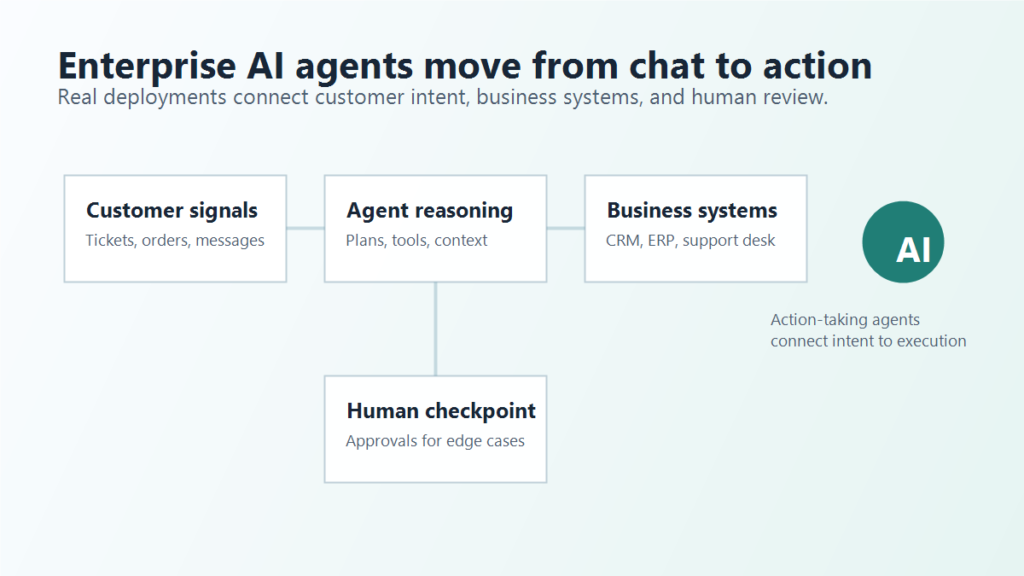

Enterprise AI agents are becoming one of the strongest technology trends of 2026 because they promise something more concrete than another chatbot: they can plan, use tools, retrieve data, trigger workflows, and hand work back to people when the risk is too high.
The signal is now visible across multiple sectors. A June 2026 research paper on OpenAI Codex usage found that agentic AI adoption grew more than fivefold in the first half of 2026, with use spreading beyond software developers into broader organizational work. In customer support, Adobe-linked reporting says 78% of organizations expect agentic AI to handle support interactions within 18 months, while only 16% have deployed it organization-wide. That gap is the story: demand is moving faster than operating maturity.
For business leaders, the question is no longer whether AI agents are interesting. It is which workflows are ready, what controls are required, and how to prove value without creating a new security problem.
What Makes an AI Agent Different From a Chatbot?
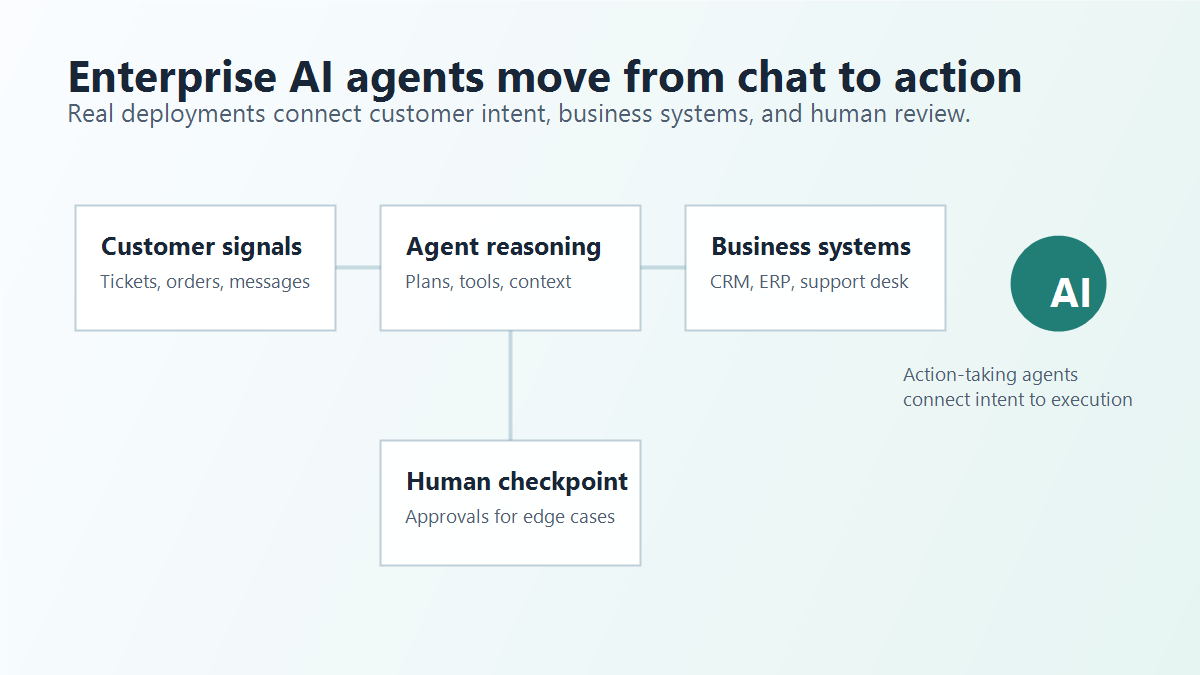
A chatbot answers. An AI agent acts.
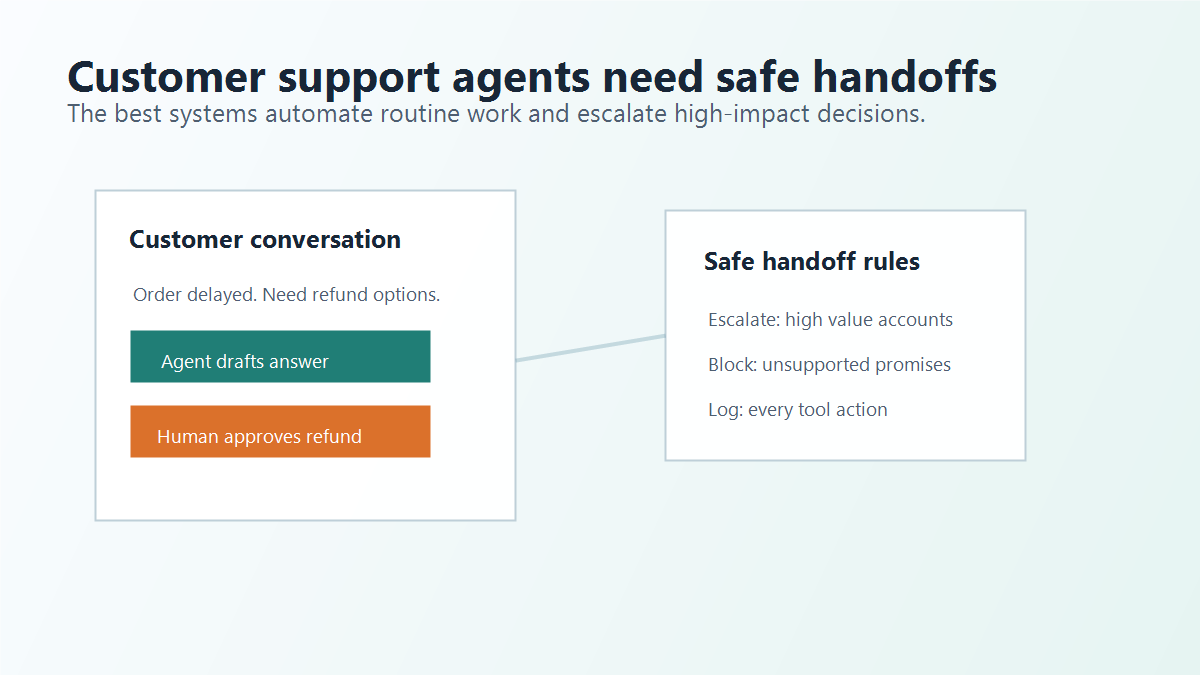
That difference matters. A conventional bot may summarize a refund policy. An agent can inspect an order, check shipping status, draft a response, prepare a refund request, and route the decision to a human approver. A support chatbot may answer FAQs. A support agent can update a CRM record, escalate a high-value account, and log every step for audit.
In practical terms, enterprise AI agents usually combine:
- A language model that interprets the goal
- Business context from documents, databases, tickets, or APIs
- Tool access, such as CRM, help desk, payment, analytics, or cloud systems
- Memory or workflow state across multiple steps
- Guardrails, permissions, logging, and human approval paths
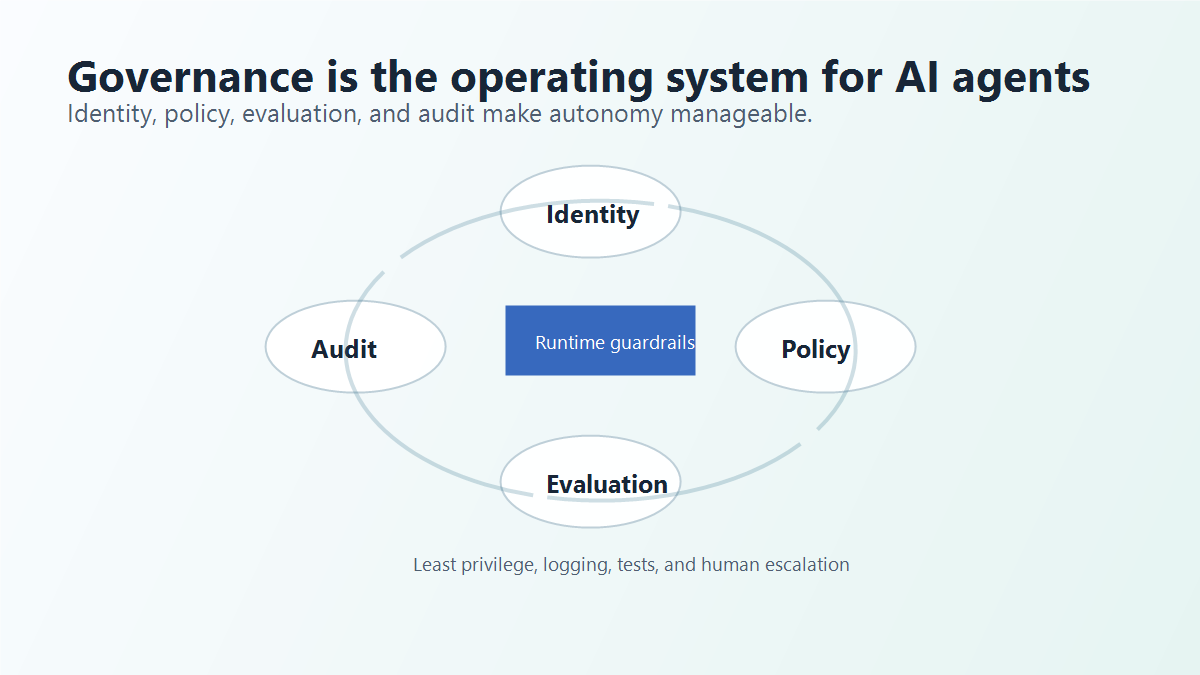
This is why the technology is powerful and risky at the same time. The closer an agent gets to real systems, the more it needs identity, access control, evaluation, and auditability.
Real-World Applications Emerging Now
Customer Support and Service Operations
Customer support is the clearest near-term use case because the work is repetitive, measurable, and tied directly to customer satisfaction. A June 2026 paper on customer support agents at Nubank, a financial services company with more than 100 million users, describes five production deployments across card delivery, debt management, credit-limit support, card management, and product explanation.
The most important takeaway is not just that the agents worked. It is that the team treated evaluation as production infrastructure. The paper reports a 37 percentage-point improvement in AI transactional Net Promoter Score and a 29 percentage-point gain in self-service rate in one card-delivery deployment, while keeping human-in-the-loop iteration central to the process.
For businesses, that points to a practical pattern: AI agents perform best when the workflow is narrow, the knowledge base is structured, and success can be measured against real customer outcomes.
IT Operations and Incident Response
Agentic AI is also gaining traction in observability and operations. A 2026 Adobe e-commerce research paper describes an agentic observability system that triages alerts by retrieving logs, consulting runbooks, analyzing recent code changes, and recommending next steps. The authors report a 90% reduction in mean time to insight compared with manual triage while maintaining comparable diagnostic accuracy.
This type of agent does not replace site reliability engineers. It reduces the time spent assembling context so engineers can decide faster. For teams drowning in alerts, that distinction is important.
Internal Workflow Automation
Many businesses will first see value in internal workflows: drafting procurement summaries, preparing sales follow-ups, reconciling tickets, generating compliance evidence, routing invoices, or updating project records. These tasks have three useful traits: they are frequent, time-consuming, and usually reversible before final approval.
The best early candidates are not the most glamorous. They are the workflows where employees already copy information between systems and where delays create measurable cost.
The Business Impact: Speed, Scale, and Better Handoffs
The business case for enterprise AI agents usually falls into four buckets.
First, agents reduce cycle time. They can gather context, draft actions, and prepare decisions faster than a person moving manually between systems.
Second, they improve consistency. A well-designed agent can apply the same policy, tone, checklist, and escalation criteria across thousands of interactions.
Third, they make expertise easier to distribute. A junior support rep or operations analyst can work with an agent that has access to current procedures, examples, and constraints.
Fourth, they expose process gaps. If an agent cannot complete a workflow safely, that often reveals messy permissions, stale documentation, weak data quality, or unclear ownership. Those problems existed before AI. Agents make them visible.
The Risks: Why Governance Is Not Optional
AI agents introduce risk because they collapse the distance between language and action. If a normal chatbot gives a poor answer, the damage may be reputational. If an agent has tool access, the damage can include data exposure, unauthorized transactions, broken workflows, or compliance failures.
OWASP’s Top 10 for Large Language Model Applications highlights several risks that become more serious in agentic systems, including prompt injection, insecure plugin design, sensitive information disclosure, excessive agency, and overreliance. Prompt injection is especially relevant because agents often read untrusted content from emails, web pages, tickets, documents, and databases.
NIST’s AI Risk Management Framework is useful here because it pushes organizations to govern, map, measure, and manage AI risk across the system lifecycle. In agent deployments, that means mapping what the agent can see, what it can change, which tools it can call, who owns it, what logs are retained, and when a human must approve the next step.
A Practical Implementation Playbook
1. Start With One Bounded Workflow
Do not begin with a general-purpose employee replacement. Start with a workflow that has a clear trigger, clear inputs, clear allowed actions, and clear success metrics. Good examples include “draft a response for delayed orders,” “triage low-severity alerts,” or “prepare renewal notes from CRM activity.”
2. Give the Agent Its Own Identity
Agents should not borrow a human account or a shared service account. Give each production agent a dedicated identity, least-privilege permissions, scoped credentials, and a documented owner. If the agent updates a record, the audit trail should show that the agent did it.
3. Build Evaluation Before Launch
The Nubank customer-support work is a useful model because it connects offline evaluation with online performance. Before launch, test the agent against historical tickets, edge cases, policy conflicts, adversarial prompts, and high-risk customer scenarios. After launch, monitor live outcomes, escalations, user satisfaction, and failure patterns.
4. Require Human Approval for High-Impact Actions
Refunds, cancellations, account changes, legal statements, health advice, financial commitments, and security actions should require approval until the organization has evidence that automation is safe. Human review should be part of the workflow, not an afterthought.
5. Log Every Tool Call
Every retrieved document, API call, draft, approval, rejection, and final action should be logged. Without this, teams cannot debug failures, prove compliance, measure ROI, or investigate whether a prompt injection attack changed the agent’s behavior.
Opportunities for Small and Mid-Sized Businesses
Enterprise AI agents are not only for large companies. Smaller businesses can use the same principles at a narrower scale.
A managed service provider can use an agent to summarize tickets, detect repeated incidents, draft client updates, and prepare remediation checklists. An e-commerce store can use an agent to classify support messages, retrieve order status, suggest policy-compliant responses, and flag unusual refund requests. A marketing team can use agents to collect campaign performance data and prepare weekly insights, while a human still approves recommendations before budget changes.
The opportunity is not “full autonomy.” The opportunity is better leverage: fewer manual handoffs, faster context gathering, and more consistent execution.
What Readers Should Watch Next
The next phase of enterprise AI agents will be shaped by three developments.
First, standards will become more specific. NIST released a 2026 concept note for an AI RMF profile focused on trustworthy AI in critical infrastructure, and similar guidance will influence how regulated sectors deploy agents.
Second, agent identity will become a serious security category. Businesses will need to know which agent acted, under which authority, using which data, and with which approval.
Third, the market will separate demos from operating systems. The winning agent platforms will not only generate impressive responses. They will provide permission models, evaluation tools, observability, rollback, audit trails, and integration patterns that security teams can trust.
FAQ
Are AI agents ready for production?
Yes, but only for bounded workflows with clear controls. Customer support, IT triage, and internal knowledge workflows are better starting points than open-ended autonomous decision-making.
What is the biggest risk with enterprise AI agents?
The biggest risk is giving agents too much authority without matching identity, permission, logging, evaluation, and human approval controls.
How should a business choose its first AI agent use case?
Choose a frequent workflow with measurable outcomes, low irreversible risk, clean data access, and a clear human escalation path.
Will AI agents replace customer support teams?
In most businesses, they will first change the work rather than eliminate it. Agents can handle routine steps, while humans focus on exceptions, empathy, complex decisions, and account-sensitive interactions.
Sources
- The Shift to Agentic AI: Evidence from Codex
- Building Customer Support AI Agents at 100M-User Scale
- Agentic Observability: Automated Alert Triage for Adobe E-Commerce
- NIST AI Risk Management Framework
- OWASP Top 10 for Large Language Model Applications
- MITRE ATLAS
- Economic Times: Adobe findings on AI agents in customer support